
Bird of Paradise pose is one of yoga’s most graceful postures. In fact, it blends strength, balance, and flexibility. When you master this pose, you feel accomplished. Additionally, the name brings images of tropical flowers opening to the sun.
Understanding the Bird of Paradise Pose
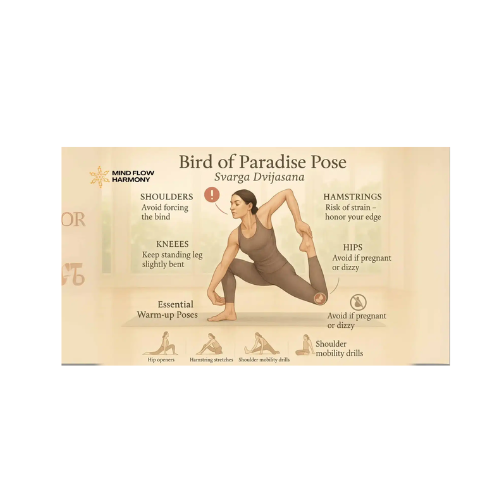
Bird of Paradise is called Svarga Dvijasana in Sanskrit. Essentially, it looks like a dancer frozen in pure grace. First, you balance on one leg. Then, your other leg extends straight to the side. At the same time, both arms wrap around the extended leg. As a result, this creates a bind that challenges your whole body.
The Origin of the Name
The pose gets its name from the bird of paradise flower. Specifically, this tropical plant has bright orange and blue petals. Moreover, they spread out like a fan. When you do this pose correctly, your body mimics the flower’s shape. For instance, your extended leg looks like petals reaching outward. Meanwhile, your standing leg is like a strong stem.
What Level Is This Pose?
Many yoga teachers call Bird of Paradise intermediate to advanced. Therefore, it needs several skills. These take time to develop through regular practice.
First of all, balance is crucial. Your entire body weight rests on one foot. Secondly, flexibility matters too. Your hips and hamstrings must open enough. Finally, core strength holds everything together. It keeps your torso upright and stable.
The Physical Benefits of Practicing Bird of Paradise
This pose brings many wonderful changes to your body. In addition, it works multiple muscle groups at once. As a result, this makes it efficient for building overall strength.
Building Leg Strength
Your standing leg develops incredible power. Specifically, it supports your entire body weight. The muscles around your ankle, knee, and hip all engage. Therefore, they work to maintain stability and prevent wobbling.
Improving Hip Flexibility
Hip flexibility improves dramatically with regular practice. Furthermore, the binding action requires your hip joint to open in several directions. Consequently, this opening can help release tension. In fact, many people notice their walking and running feel easier.
Opening Shoulders and Upper Back
Your shoulders and upper back also benefit. Specifically, wrapping your arms around the extended leg stretches your shoulders. Additionally, it opens your chest. As a result, this counters the rounded posture from computer work. Over time, you often notice improved posture.
Strengthening Your Core
Core muscles work hard to keep you balanced and upright. For example, your abdominal muscles engage. Similarly, so do your obliques and lower back muscles. Therefore, this core engagement helps build a strong center. Ultimately, it supports your spine and improves body control.
Mental and Emotional Growth Through the Pose
Beyond physical benefits, Bird of Paradise offers mental growth. In particular, the pose requires intense focus to maintain balance. As a result, this focused attention helps quiet your busy mind. Moreover, it brings you into the present moment.
Building Confidence
Confidence happens naturally through challenging poses. For instance, each small improvement provides a sense of achievement. You might hold the balance a bit longer. Alternatively, you might extend your leg a little straighter. Importantly, these victories on the mat often translate to increased confidence in life.
Learning to Let Go of Perfectionism
The pose teaches important lessons about perfectionism. In fact, very few people perform it perfectly on their first try. Instead, the journey involves many falls and wobbles. Fortunately, learning to laugh at these moments creates a healthier relationship with growth.
Preparing the Body for Bird of Paradise
Several prep poses help build necessary strength and flexibility. In addition, starting with these foundations makes the journey safer. It also makes it more enjoyable.
Key Preparatory Poses
Here are essential prep poses:
- Warrior III for balance and leg strength
- Standing splits to develop hamstring flexibility
- Bound side angle for the binding action
- Tree pose for one-legged balance
- Pigeon pose for deep hip opening
- Eagle pose for shoulder flexibility and balance
Why Hip Opening Matters
Hip opening deserves special attention. Specifically, the pose requires significant rotation in your hip. Without adequate opening, forcing the pose can lead to injury. Therefore, gentle, consistent hip opening over weeks creates the flexibility you need.
Step-by-Step Guide to Entering Bird of Paradise
Learning to enter this pose safely takes time. Additionally, it requires careful attention to alignment. To begin, starting from a standing forward fold provides a stable beginning.
Starting Position
First, begin standing at the front of your mat. Place your feet hip-width apart. Next, take a few deep breaths. Then, fold forward from your hips. Let your upper body hang toward your legs. If your hamstrings feel tight, bend your knees slightly.
Creating the Bind
From the forward fold, step your right foot back three to four feet. Then, lower your right knee to the mat. Position it slightly to the right side of your body. Next, thread your right arm underneath your right thigh. Reach it toward the left side.
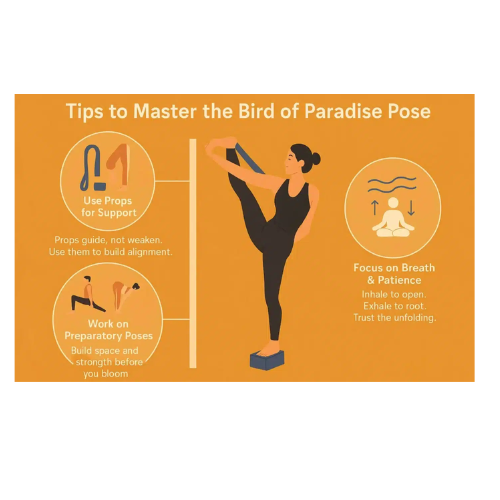
After that, bring your left arm behind your back. Work toward clasping your hands together. However, if your hands don’t reach, use a yoga strap. The strap bridges the gap. Importantly, never force your hands to clasp if it creates pain.
Rising Into the Pose
Once the bind feels secure, slowly straighten your left standing leg. Clearly, this requires both strength and balance. Therefore, move gradually and breathe deeply. If balance feels unstable, keep a slight bend in your standing leg.
Extending the Leg
Finally, start to straighten your right leg. Lift it up and out to the side. Importantly, the leg should extend from your hip socket. Keep your foot flexed. This protects your knee joint. Additionally, your torso may need to lean slightly left to maintain balance.
Common Mistakes and How to Avoid Them
Many people make similar mistakes when learning this pose. Fortunately, recognizing these issues helps you progress more safely.
Forcing the Bind
One frequent mistake is forcing your hands to clasp. Typically, this happens before your shoulders have adequate flexibility. Unfortunately, this forcing can strain your shoulder joint. Moreover, it can also cause your chest to collapse forward.
Rushing the Extension
Another common error is trying to extend the lifted leg too soon. First, you need solid balance on your standing leg. Otherwise, rushing through the stages often leads to wobbling. Instead, take extra time to feel stable at each step.
Holding Your Breath
Holding your breath is a subtle but important mistake. Usually, it indicates too much tension. Instead, maintain steady, even breathing throughout the pose. As a result, this signals that your body is working within its capabilities.
Poor Standing Leg Alignment
Proper alignment of your standing leg creates stability. Specifically, your standing foot should press firmly into the mat. Distribute weight evenly across all four corners. Additionally, your toes should spread wide. Your arch should lift slightly.
Modifications for Different Body Types and Abilities
Not every body moves the same way. In fact, Bird of Paradise demonstrates this truth clearly. Some people have naturally mobile hips. In contrast, others have tighter hips that need more preparation.
Using a Yoga Strap
A yoga strap extends the reach of your arms. Specifically, use it when your hands can’t clasp together. Simply hold each end of the strap. As a result, this creates a similar binding effect. Over time, as flexibility increases, walk your hands closer together along the strap.
Wall Support for Balance
Wall support offers helpful modification for balance work. First, stand near a wall. Then, use light fingertip contact for stability. Consequently, this approach builds confidence. You can explore the full extension without fear of falling.
Keeping the Lifted Leg Bent
Keeping your lifted leg bent is a perfectly valid modification. In fact, it still provides many benefits. You still get hip opening, core strengthening, and balance training. Moreover, working with a bent knee can help some people find better alignment.
Integrating Bird of Paradise Into a Yoga Sequence
Bird of Paradise works beautifully as a peak pose. However, building toward it requires thoughtful preparation. This warms up all the necessary body parts.
Warming Up
Start with sun salutations. They warm up your entire body. Additionally, they begin to build heat in your muscles. After several rounds, add standing poses. For example, warriors and triangles prepare your legs and hips.
Specific Hip Openers
Next, move into specific hip openers. Poses like low lunge work well. Similarly, pigeon and bound side angle are excellent choices. These directly prepare your hips. Therefore, spend adequate time in these prep poses.
Counter Poses
After working with Bird of Paradise, include counter poses. First, forward folds help release any tension in your lower back. Then, gentle twists restore neutral alignment to your spine. Finally, hip stretches in a seated position allow your hip joints to relax.
The Role of Breath in Bird of Paradise
Breathing technique plays a crucial role in this pose. In fact, your breath serves as a bridge between mind and body. When your breath flows smoothly, your body can relax into the challenge.
Inhaling During Setup
Inhale during the setup phases. This helps create space in your body. For instance, as you thread your arm and clasp your hands, breathing in expands your ribcage. Consequently, this expansion makes the bind feel more comfortable. The inhalation also energizes your body.
Exhaling Into the Pose
Exhale while straightening your legs. Similarly, exhale while lifting into the full pose. As a result, this helps engage your core muscles. The exhalation naturally draws your abdominal muscles inward. Therefore, this creates the stability needed for balance.
Maintaining Steady Breath
Keep steady breathing while holding the pose. This indicates the pose is sustainable. However, if your breath becomes ragged or strained, the pose has gone too far. Instead, back off slightly until smooth breathing returns.
Teaching Bird of Paradise to Others
Yoga teachers face unique challenges with this pose. Different students struggle with different aspects. For example, some find balance easy but the bind impossible. In contrast, others have flexible hips but weak legs.
Clear Verbal Cues
Clear verbal cues help students understand the mechanics. Specifically, describe the actions in simple language. As a result, this allows students to feel their way into the pose. For instance, you might say “thread your arm like you’re reaching under a fence.”
Hands-On Adjustments
Hands-on adjustments require extra care. The pose puts students in a vulnerable position. Specifically, they’re actively working to maintain balance. Therefore, any unexpected touch might cause them to fall. Always ask permission before offering physical adjustments.
Encouraging a Growth Mindset
Encourage a growth mindset. Help students approach the pose with patience. For example, remind them that everyone falls sometimes. In fact, falling is part of the learning process. Additionally, share your own experiences of struggling with the pose.
Bird of Paradise Variations to Explore
Once you develop comfort with the basic form, several variations offer new challenges. These can make the pose more accessible. Alternatively, they can make it more challenging.
Bent Leg Variation
One variation keeps the bound leg bent. You don’t extend it straight. Nevertheless, this version still requires significant balance. It offers excellent hip opening benefits. Interestingly, the bent leg variation might be more challenging for some people.
Released Bind Variation
Another variation releases the bind once the leg extends fully. First, you extend your leg out to the side. Then, release your hands. Bring both arms overhead or out to the sides. As a result, this variation requires even more balance.
Flying Bird of Paradise
Flying Bird of Paradise is an advanced level variation. From the full extended position, you hinge forward at your hips. Meanwhile, you maintain the straight leg extension. This requires exceptional hamstring flexibility. Therefore, only experienced practitioners should attempt this.
Overcoming Fear and Building Trust in the Practice
Fear often appears with challenging poses. For instance, the fear of falling or looking foolish can prevent full engagement. However, working through these fears builds psychological resilience.
Using Support
Start your practice near a wall. Alternatively, use a chair for support. These tools provide a safety net. Consequently, they allow you to explore your edge without excessive anxiety. As confidence grows, you can gradually remove external supports.
Learning from Falls
Falling out of the pose repeatedly teaches important lessons. It teaches persistence and self-compassion. In fact, each fall provides information. You learn what needs adjustment. Therefore, view falls as feedback rather than failure.
Trusting Your Body
Trust your body’s inherent wisdom. Your body knows when it’s ready to attempt something. Similarly, it knows when it needs more preparation. Learn to listen to these internal signals. As a result, this prevents injury and creates sustainable practice.
The Symbolism and Deeper Meaning of Bird of Paradise
Many yoga poses carry symbolic meanings. These add depth to physical practice. Specifically, Bird of Paradise symbolizes freedom and beauty. It represents the ability to rise above challenges.
Embracing Your Unique Journey
Practicing this pose can remind you of your own unique beauty. The bird of paradise flower blooms in its own time and way. Similarly, each practitioner unfolds into the pose according to their own timeline. Therefore, comparing progress to others becomes meaningless.
Finding Balance Between Effort and Ease
The balancing aspect represents balance needed in life. You need balance between effort and ease. Between working hard and allowing things to flow naturally. Pushing too hard leads to tension. Conversely, not applying enough effort means the pose never fully forms.
Creating Freedom Within Constraints
The bind can symbolize how people sometimes feel restricted. However, working to create space within the bind teaches valuable lessons. It mirrors the work of creating freedom within life’s necessary constraints. Everyone has responsibilities and limitations. Nevertheless, within those boundaries, tremendous freedom remains possible.
Troubleshooting Common Challenges in Bird of Paradise
Different people encounter different obstacles. For instance, some find balance nearly impossible. In contrast, others can balance easily but can’t create the bind.
Improving Balance
For those who struggle with balance, spend extra time in simple one-legged poses. Tree pose helps. Similarly, standing hand to big toe pose and warrior three are beneficial. Practice these poses regularly, perhaps daily. As a result, this creates the neural pathways needed for complex balancing work.
Opening Tight Hips
Tight hips present another common challenge. Fortunately, a dedicated hip opening practice makes tremendous differences over time. Try poses like pigeon and cow face pose. Additionally, various seated hip stretches gradually increase range of motion. Importantly, consistency matters more than intensity.
Increasing Shoulder Mobility
Shoulder and upper back tightness often prevents the hands from clasping. Fortunately, regular shoulder opening work addresses this limitation. Try poses like cow face arms and eagle arms. Furthermore, various shoulder stretches help create the mobility needed for binding poses.
Injury Prevention and Safe Practice Guidelines
Practicing this pose safely requires awareness of potential risks. In fact, the complex nature of the pose means multiple body parts could experience strain.
Protecting Your Ankle
Your standing leg and ankle face significant demands. All your body weight concentrates on one foot. Therefore, any instability in your ankle can lead to strains. Build ankle strength through exercises like calf raises. Additionally, people with previous ankle injuries should progress slowly.
Safeguarding Your Hip
Your hip joint works at the outer ranges of its mobility. Forcing your leg into extension before adequate flexibility can damage structures within your hip. Therefore, never push through sharp or pinching sensations. Dull stretching sensations indicate productive work. However, sharp pains signal potential danger.
Caring for Your Shoulders
Your shoulders and upper back can experience strain from the binding action. Don’t force your hands together before adequate mobility exists. Instead, use a strap to prevent excessive strain. If any shooting pains or numbness occur in your arms, release immediately.
Protecting Your Knee
Your knee joint needs protection through proper alignment. Specifically, your leg should extend from your hip rather than just straightening at your knee. Keep your foot flexed. Also, keep your leg muscles engaged. This protects your knee from hyperextension.
Personal Stories of Growth Through Bird of Paradise
Many yoga practitioners have transformative experiences with this pose. In fact, the pose often becomes a mirror. It reflects back personal strengths and areas for growth.
Discovering Inner Strength
Some students discover unexpected reserves of strength. The journey might take months or even years. It requires consistent effort and patience. Furthermore, each small increment of progress builds confidence. These lessons often transfer to other challenging situations in life.
Learning Self-Acceptance
Other practitioners find the pose teaches them about perfectionism. The pose rarely looks exactly like pictures in yoga books. However, learning to appreciate their unique expression helps students develop more compassionate relationships with their bodies.
Finding Present Moment Awareness
For some yogis, Bird of Paradise becomes a meditation on the present moment. The pose requires such focused attention that the mind naturally quiets. Distractions fall away. In fact, even just a few seconds of steady balance can feel like profound meditation.
The Evolution of Bird of Paradise in Modern Yoga
Bird of Paradise has become increasingly popular in contemporary yoga classes. In fact, the pose appears frequently in social media yoga content. As a result, this makes it recognizable even to people who don’t practice yoga regularly.
The Positive Side of Visibility
Increased visibility inspires more people to try yoga. For instance, seeing beautiful expressions of the pose can motivate beginners. It can help them stick with practice through the early awkward stages. Moreover, the pose demonstrates the amazing capabilities of the human body.
The Challenge of Social Media
However, emphasis on advanced poses in social media can create unhealthy comparison. It can create unrealistic expectations. For example, beginners might feel discouraged. Therefore, teachers must help students understand that the journey matters more than the destination.
Different Approaches Across Traditions
Different yoga lineages approach Bird of Paradise in various ways. Some styles emphasize the aesthetic qualities. They encourage dancer-like grace and extension. In contrast, other traditions focus more on the internal experience. Neither approach is inherently better.
Complementary Practices That Support Bird of Paradise
Cross-training and complementary practices can significantly enhance your ability. In fact, activities outside traditional yoga classes build strength and flexibility. Therefore, taking a holistic approach to fitness creates a well-rounded foundation.
Strength Training Benefits
Strength training builds the muscular foundation needed for balancing poses. Specifically, exercises that target your legs and core work especially well. For example, squats, lunges, and deadlifts develop leg strength. Similarly, planks and side planks create abdominal and back strength.
Dance and Movement Practices
Dance and other movement practices develop body awareness. They develop grace that enhances yoga practice. Furthermore, taking dance classes helps you understand how to move fluidly between poses. The musicality of dance translates beautifully into yoga.
Dedicated Flexibility Work
Flexibility training through dedicated stretching sessions complements yoga practice effectively. Specifically, spending time in longer-held passive stretches increases range of motion. As a result, this additional flexibility work can help unlock poses like Bird of Paradise.
Balance Training Exercises
Balance training through specific exercises sharpens proprioceptive skills. Simple practices help. For instance, try standing on one foot while brushing your teeth. Additionally, balance boards and wobble cushions add challenge. They keep your nervous system engaged and adapting.
Frequently Asked Questions About Bird of Paradise
What level of yoga experience do I need?
Bird of Paradise is considered intermediate to advanced. Therefore, having at least six months to a year of regular practice is recommended. Before attempting this pose, you should feel comfortable with basic standing poses. Additionally, you should have experience with simple balancing poses like tree pose. Working with a qualified teacher makes the learning process safer.
Why can’t I get my hands to clasp?
Difficulty clasping your hands usually indicates tightness in your shoulders or upper back. In fact, this limitation is very common. Don’t feel discouraged. Instead, use a yoga strap to bridge the gap between your hands. This allows you to experience all the other benefits of the pose. Furthermore, regular shoulder opening exercises help increase mobility over time.
How long should I hold the pose?
When first learning, even holding the pose for three to five breaths is a significant achievement. As strength develops, you can work up to five to ten breaths. However, quality always matters more than duration. Holding the pose for fewer breaths with good alignment provides more benefits.
Is it normal to fall out frequently?
Falling out of balancing poses is completely normal. In fact, it happens to practitioners at all levels. Balance naturally fluctuates based on energy levels and stress. Rather than viewing falls as failures, see them as opportunities. They let you practice patience and humor. With consistent practice, falls usually decrease.
Can this pose help with injuries?
Bird of Paradise can support overall strength and flexibility. It contributes to general health and wellbeing. However, the pose should not be considered a treatment for specific medical conditions. People with hip, knee, or ankle injuries should consult healthcare providers first. Additionally, pregnant women should avoid poses that require intense balancing.
Conclusion
Bird of Paradise stands as one of yoga’s most beautiful poses. It offers opportunities for physical development and mental growth. Furthermore, the journey toward mastering this pose teaches valuable lessons. You learn about patience, persistence, and self-compassion. Importantly, these lessons extend far beyond the yoga mat.
The full expression requires significant strength, flexibility, and balance. However, every practitioner can work with some version of this pose. You can find a version that meets you at your current level.
The pose reminds yogis that beauty and grace can be found in the process. Not just in achieving the goal. In fact, each wobble and each fall contributes to the rich tapestry of your yoga journey. Whether you practice for physical benefits, mental clarity, or simply the joy of movement, Bird of Paradise offers something valuable.
Approach this pose with respect for your individual limitations. Additionally, commit to safe, mindful practice. This ensures the experience remains positive and beneficial. The pose serves as a beautiful metaphor for life itself. It requires balance between effort and ease. Between reaching for goals and accepting what is.
Through dedicated practice and patient persistence, most students eventually find their own unique expression of this stunning pose. They bloom like the tropical flower for which it is named.