
Have you ever thought about sharing your yoga practice with someone special? Doing yoga with a partner can make your practice more fun and meaningful. When two people practice yoga together, they can help each other get deeper into poses. They also build trust and create a strong connection that goes beyond the yoga mat.
Partner yoga is not just about being flexible or strong. It’s about working together as a team and supporting each other through every movement. You don’t need to be an expert to try these poses. All you need is a willing partner and an open mind. Whether you practice with a friend, family member, or romantic partner, these poses will bring you closer together.
Many people find that practicing yoga with another person makes the experience more enjoyable. You can laugh together when things get wobbly. You can encourage each other when poses feel challenging. Most importantly, you can celebrate small victories together. This shared experience creates memories that last long after you roll up your mat.
Yoga Poses for Two: How to get into the Poses
Before you start any partner yoga practice, you need to prepare properly. Communication is the most important part of working with another person. Talk to your partner about any injuries or areas that feel uncomfortable. Set up a safe space where both of you can move freely without bumping into furniture or walls.
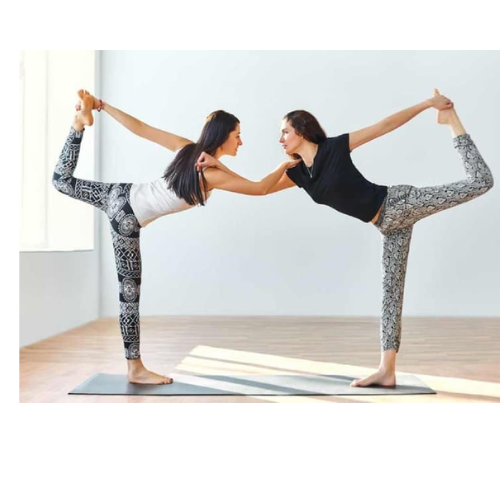
Warm up your bodies before attempting any partner poses. Spend at least five to ten minutes doing simple stretches and breathing exercises. This helps prevent injuries and makes the poses easier to hold. Remember that partner yoga is not a competition. Go at a pace that feels comfortable for both people.
Always start with easier poses and gradually move to more challenging ones. If something doesn’t feel right, speak up immediately. Your partner cannot read your mind, so clear communication keeps everyone safe. When you’re ready to try a pose, move slowly and check in with each other often. This mindful approach makes partner yoga both safe and enjoyable.
Seated Partner Twist
The seated partner twist is a wonderful way to begin your partner yoga journey. This pose helps stretch your spine and improves flexibility in your back. It also encourages you and your partner to breathe together, which creates a peaceful rhythm.
To get into this pose, sit back-to-back with your partner on the mat. Both of you should sit with your legs crossed in a comfortable position. Press your backs firmly against each other to create a stable base. Take a few deep breaths together and feel each other’s breathing patterns.
On an inhale, both partners should lengthen their spines and sit up tall. On the exhale, both of you twist to the right side. Place your right hand on your partner’s left knee and your left hand on your own right knee. Keep your backs pressed together as you twist. Hold this position for five to eight breaths, then slowly return to center and twist to the other side.
This pose works because you can use your partner’s body as resistance. When you twist, you might find you can go a little deeper than when practicing alone. The pressure of your backs together also helps both partners maintain good posture. You can feel your partner’s breath moving through their body, which creates a beautiful sense of connection.
Seated Wide Leg Forward Fold
The seated wide leg forward fold with a partner offers an amazing stretch for your inner thighs and hamstrings. This pose requires trust because one partner will be pulling while the other relaxes into the stretch. It’s a perfect example of how partner yoga creates balance through give and take.
Start by sitting on the floor facing your partner with your legs spread wide. Your feet should touch or press against your partner’s feet. Both of you should flex your feet and keep your legs straight. Sit up tall and take a moment to find a comfortable position where your feet connect.
One partner will fold forward first while the other stays upright. The person folding forward reaches out to hold their partner’s hands or wrists. The upright partner gently pulls back, helping their friend stretch deeper into the forward fold. The person folding forward should keep their spine long and hinge from the hips. Hold this stretch for five to ten breaths.
After the first person has their turn, switch roles. The partner who was pulling back now gets to fold forward and receive the stretch. This back-and-forth creates a natural flow in your practice. Remember to pull gently and never force your partner deeper than feels comfortable. Communication is key to making this pose safe and effective.
Child’s Pose
Child’s pose is known as a resting pose in regular yoga practice. When you add a partner, it becomes something special and deeply relaxing. This version creates gentle pressure on the lower back, which many people find soothing and therapeutic.
The first partner comes into a traditional child’s pose on the mat. Kneel on the floor, sit back on your heels, and fold forward with your arms extended. Your forehead should rest on the mat and your body should feel completely relaxed. Take a few breaths in this position to settle in.
The second partner carefully sits on the first person’s sacrum, which is the flat bone at the base of the spine. The second partner should sit gently and check in to make sure the weight feels good. From here, the second partner can fold forward into their own child’s pose, draping their body over their partner’s back.
This double child’s pose creates a beautiful sandwich effect. The person on the bottom gets a gentle weighted stretch that feels like a comforting hug. The person on top gets the benefits of a traditional child’s pose plus the warmth of their partner beneath them. Stay in this pose for eight to ten breaths, then carefully separate and switch positions.
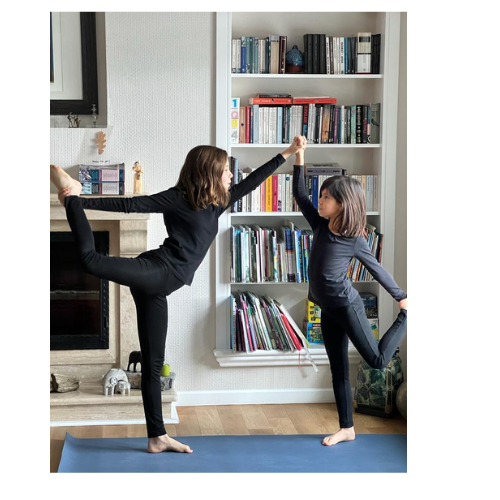
Extended Hand to Foot Pose (Uttitha Hasta Padangusthasana C)
The extended hand to foot pose challenges your balance and flexibility at the same time. When you do this pose with a partner, it becomes easier because you have someone to help you stay steady. This pose strengthens your legs and improves your ability to focus.
Both partners stand facing each other at arm’s length apart. Stand on your left leg and lift your right leg out to the side. Reach across with your left hand to hold your partner’s right hand. Your other hands can hold each other too for extra stability. Keep your standing leg strong and straight.
Work together to find your balance. You might wobble at first, and that’s completely normal. The connection between your hands helps both of you stay more stable than you could alone. Keep your gaze fixed on a point that doesn’t move. This helps your brain maintain balance.
Hold the pose for five to eight breaths on one side. Then carefully lower your legs and switch to the other side. Stand on your right leg and lift your left leg out to the side this time. The beauty of this pose is that when one partner feels unsteady, the other can provide extra support. You truly rely on each other to succeed.
Downward Facing Dog & L-Shape Handstand
This combination pose looks impressive and builds serious strength in both partners. One person creates a stable base in downward facing dog while the other person uses that base to practice an L-shaped handstand. It requires trust, strength, and careful positioning.
The first partner comes into downward facing dog pose. Press your hands firmly into the mat with fingers spread wide. Lift your hips high and press your heels toward the floor. Your body should form an upside-down V shape. Make sure you feel strong and stable before your partner begins.
The second partner stands facing the first person’s downward dog from the feet end. Place your hands on the mat about one foot in front of your partner’s feet. Step one foot onto your partner’s lower back or hips, then carefully bring the other foot up to meet it. Your legs should be straight and parallel to the floor, creating an L shape with your body.
Communication is absolutely essential for this pose. The person in downward dog should say if the weight feels wrong or uncomfortable. The person in the handstand should move slowly and mindfully. Hold the L-shape for three to five breaths if possible, then carefully step down one foot at a time. Switch roles so both partners get to try each position.
Parighasana (Gate Pose)
Gate pose with a partner creates a beautiful side stretch that opens up your entire body. This pose helps stretch the muscles between your ribs and improves your breathing capacity. When done with a partner, you can create matching shapes that look like decorative gates.
Both partners kneel on the mat facing the same direction, side by side. Extend your outside leg straight out to the side with your foot flat on the floor. Your inside knee stays on the mat. Reach your outside arm up and over your head toward your extended leg. Place your other hand on your extended thigh.
As you both stretch to the side, you can reach toward each other and hold hands overhead. This connection helps both partners stretch a little deeper. You should feel the stretch along the entire side of your body from your hip to your fingertips. Keep breathing steadily and don’t hold your breath.
Hold gate pose for five to eight breaths on one side. Come back to center carefully, then switch sides. Extend your other leg and stretch in the opposite direction. The symmetry of doing this pose together creates a sense of harmony. You move as one unit while still experiencing your own individual stretch.
Boat Pose (Grabbing Hands)
Boat pose is challenging when you practice alone because it requires core strength and balance. When you practice with a partner and hold hands, it becomes a fun balancing act that tests your teamwork. This pose strengthens your abdominal muscles and improves your ability to focus.
Sit on the floor facing your partner with your knees bent and feet flat. Scoot close enough that you can reach forward and hold each other’s hands or wrists. Make sure you have a firm but comfortable grip. This connection point will help you both balance.
Lift your feet off the floor and touch the soles of your feet against your partner’s feet. Slowly begin to straighten your legs while keeping your feet pressed together. As your legs straighten, your bodies will form a V shape. Engage your core muscles to keep your back straight and your chest lifted.
Finding the balance point takes practice and patience. You’ll probably wobble and maybe even fall out of the pose a few times. That’s part of the fun! Keep trying and working together. Hold the pose for five to ten breaths when you find your balance. Lower your feet down slowly and rest before trying again.
Camel Pose
Camel pose is a deep backbend that opens your chest and stretches the front of your body. Practicing this pose with a partner provides extra support and makes the backbend feel safer. This pose can be intense, so move carefully and listen to your body.
Both partners kneel on the mat facing away from each other, about two feet apart. Your knees should be hip-width apart and your shins pressed firmly into the floor. Place your hands on your lower back for support. Take a few breaths to prepare mentally for the backbend.
Begin to arch your back and lean backward toward your partner. One at a time, reach your hands back to grasp your heels. If you can’t reach your heels, keep your hands on your lower back for support. As you both lean back, your shoulders might touch or your bodies might create support for each other.
The key to safe backbending is engaging your core and not just collapsing into your lower back. Press your hips forward and lift your chest toward the ceiling. Breathe deeply into your chest. Hold camel pose for three to five breaths, then come up slowly by bringing your hands back to your lower back and lifting your torso upright.
Savasana (Because No Class is Complete without Savasana)
Savasana, also called corpse pose, is the final resting pose in every yoga class. This is when your body absorbs all the benefits of your practice. Partner savasana adds an extra layer of comfort and connection that makes relaxation even deeper.
Both partners lie down on their backs on the mat. You can lie next to each other with your shoulders touching, or you can lie in opposite directions with your heads near each other. Some partners like to hold hands during savasana. Choose whatever position feels most comfortable and relaxing for both of you.
Close your eyes and let your body become completely heavy on the mat. Release any effort or tension you’re still holding. Focus on your breath and feel it moving gently in and out of your body. Notice the presence of your partner nearby. This shared quiet time creates a peaceful bond.
Stay in savasana for at least five to ten minutes. This rest period is not optional or something to skip. Your nervous system needs this time to reset and your muscles need time to recover. When you’re ready to finish, wiggle your fingers and toes gently. Roll to one side and slowly push yourself up to a seated position. Take a moment to thank your partner for practicing with you.
When to Practice Yoga Poses for Two
Timing matters when you plan a partner yoga session. The best time to practice is when both people feel energized but not rushed. Early morning can be wonderful because your mind is clear and the day hasn’t filled up with stress. Morning practice sets a positive tone for the entire day ahead.
Evening practice works well too, especially after work or school. Partner yoga helps you unwind from daily stress and reconnect with your practice buddy. Just make sure you practice at least two hours after eating a large meal. Doing yoga on a full stomach feels uncomfortable and can cause digestive issues.
Choose a time when you won’t be interrupted. Turn off phones and other devices that might distract you. Let other people in your home know that you need quiet time. Creating this dedicated space and time shows respect for your practice and your partner.
Consider making partner yoga a regular appointment in your schedule. Many partners practice together once or twice a week. This consistency builds your skills and strengthens your relationship. You’ll start to notice improvements in how well you communicate and work together. The benefits extend far beyond the physical poses into everyday life.
Stay up to date and never miss out
Staying connected with the yoga community helps you grow in your practice. Following yoga teachers and studios online gives you access to new ideas and inspiration. You can learn different variations of poses and discover sequences you’ve never tried before.
Social media platforms offer countless free yoga resources. You can watch videos that demonstrate partner poses clearly. You can join online communities where people share their experiences and ask questions. This connection to other practitioners reminds you that you’re part of something bigger.
Subscribing to yoga newsletters keeps fresh content coming to your inbox. Many teachers share tips, pose breakdowns, and philosophical teachings through email. This regular contact with yoga wisdom helps keep your practice alive even when you can’t get on the mat.
Consider following yoga accounts that specifically focus on partner work. These specialized resources offer targeted advice for the unique challenges of practicing with another person. You’ll find troubleshooting tips and progressions that help you advance safely. The yoga community is welcoming and supportive, ready to help you on your journey.
Online Yoga Teacher Training Courses
If partner yoga sparks a deeper interest in yoga, you might consider formal training. Many people start as casual practitioners and discover they want to learn more about yoga’s rich history and philosophy. Teacher training programs offer comprehensive education that transforms your understanding of yoga.
Online training programs have become increasingly popular and accessible. You can learn from experienced teachers without traveling far from home. These programs cover anatomy, teaching methods, philosophy, and of course, lots of practice. They’re designed to deepen your personal practice whether or not you plan to teach professionally.
Teacher training creates a structured path for growth. Instead of randomly trying poses, you follow a curriculum that builds systematically. You learn why poses work the way they do. You understand how to practice safely and how to help others do the same. This knowledge makes you a more confident and capable practitioner.
200 Hour Online Yoga Teacher Training
The 200 hour training is the foundation level certification in yoga. This program introduces you to all the essential elements of yoga practice and teaching. You learn basic anatomy, how to sequence classes, and how to communicate clearly with students. Many people complete this training purely for personal growth.
This training typically covers several months of study. You’ll attend live online classes where you can ask questions and interact with teachers. You’ll also complete assignments and practice teaching to small groups. The comprehensive nature of this program gives you a solid understanding of yoga as a complete practice.
Finishing a 200 hour training opens doors to continue learning. You’ll be eligible to register with Yoga Alliance, which is the main professional organization for yoga teachers. Even if you never teach a public class, the confidence and knowledge you gain enriches your life. You become part of a global community of trained practitioners.
300 Hour Online Yoga Teacher Training
The 300 hour training is an advanced program for people who have already completed a 200 hour certification. This deeper dive explores more complex poses, advanced anatomy, and specialized teaching skills. You might focus on areas like partner yoga, therapeutic applications, or specific populations like seniors or children.
This training assumes you already have a strong foundation in yoga basics. The teaching goes deeper into philosophy and the subtle energy systems of the body. You learn refinements that make your practice more precise and therapeutic. Many teachers say their 300 hour training completely transformed how they understand yoga.
Advanced training also covers business skills if you want to teach professionally. You learn how to create a teaching schedule, market your classes, and build a sustainable career. Even if business isn’t your focus, these organizational skills help you manage your personal practice more effectively.
500 Hour Online Yoga Teacher Training
The 500 hour designation means you’ve completed both a 200 hour and 300 hour training program. This represents a serious commitment to yoga study. People with 500 hour certifications have invested significant time and energy into understanding yoga deeply. They’re recognized as experienced practitioners and teachers.
Some schools offer integrated 500 hour programs that you complete all at once. These comprehensive programs take you from beginner teacher to advanced practitioner in one continuous journey. The integrated approach creates seamless learning without gaps between training levels. You build knowledge systematically over many months.
Achieving a 500 hour certification positions you as a serious yoga professional. Many studios prefer hiring teachers with this level of training. More importantly, you have the depth of knowledge to teach safely and effectively. Your practice becomes rich with understanding that goes far beyond physical poses. You truly embody what it means to be a yogi.
Frequently Asked Questions
What should I wear for partner yoga? Wear comfortable, fitted clothing that allows full range of movement. Avoid loose or baggy clothes that might get in the way when your partner helps you with poses. Choose breathable fabrics that keep you comfortable throughout practice. Many people prefer yoga pants or leggings with a fitted top.
Do I need to be flexible to do yoga poses for two? No, you don’t need to be flexible to start partner yoga. Many partner poses actually help you become more flexible over time. Your partner can assist you in reaching deeper stretches safely. Start with beginner poses and gradually progress as your flexibility improves. Everyone has to start somewhere.
Can I practice partner yoga with someone much taller or shorter than me? Yes, height differences don’t prevent partner yoga practice. You may need to adjust some poses slightly to accommodate different body sizes. Communication becomes even more important when partners have different proportions. Most poses can be modified to work for any height combination. Focus on connection rather than perfect alignment.
How often should we practice yoga poses for two? Start with one or two sessions per week to build consistency. Each session can last 30 to 60 minutes depending on your schedule. Regular practice creates the most benefits for strength, flexibility, and relationship building. Listen to your bodies and rest when you need recovery time. Quality matters more than quantity.
Is partner yoga appropriate for romantic couples only? Partner yoga works wonderfully for any two people who want to practice together. Friends, family members, parents with children, and workout buddies all enjoy partner yoga. The connection you build is about trust and teamwork, not romance. Choose a partner you feel comfortable with and communication comes easily. The practice adapts to any relationship dynamic.
Conclusion
Yoga poses for two open up a whole new dimension of practice that goes beyond what you can do alone. When you practice with a partner, you share energy, support, and encouragement. These shared experiences create bonds that strengthen both your yoga practice and your relationship with your practice partner.
Starting with basic poses builds your confidence and communication skills. As you progress to more challenging poses, you learn to trust each other completely. This trust carries over into other areas of your life. You become better at working as a team and supporting others through challenges.
Remember that partner yoga is not about perfection or achieving impressive poses. The real magic happens in the moments of struggle and laughter. When you wobble and catch each other, you’re building something valuable. When you successfully hold a challenging pose together, you celebrate a shared victory. These moments create memories and deepen connections.
Whether you practice with a friend, family member, or romantic partner, partner yoga offers something special. You get all the physical benefits of regular yoga plus the emotional rewards of sharing the experience. Your practice becomes richer and more meaningful when someone else is there with you. So grab a partner, roll out two mats, and discover the joy of yoga poses for two.